
The Fire Horse Year, the Medicine Hat, and the river that carried me
Here in Southern Middle Tennessee, folks don’t announce a miracle. They’ll just say, “Well.. I’ll be.” They’ll say, “ That’s a sign if you’re paying attention." They’ll say, “The world’s a lot older than we are, and it’s got its ways.”
And if you grow up anywhere near these ridges and hollers, you learn early: the line between seen and unseen is thinner than polite society likes to admit.
You can feel it in certain wind. You can hear it in the creekwater at night. You can smell it when lightning’s thinking about striking.
Some years come in like a calm fresh water spring. Other years come in like fire.
And I don’t care what the tidy people call it— when River came into my life, it was my Year of the Fire Horse.
Not cute, not clean, not convenient. The kind of year that burns the lies right off your skin. The kind that makes you tell the truth or choke on it.
And wouldn’t you know it: He came to me already named River, like the universe was trying to lace water through flame and call it balance.
The Horse with a Hat of Medicine
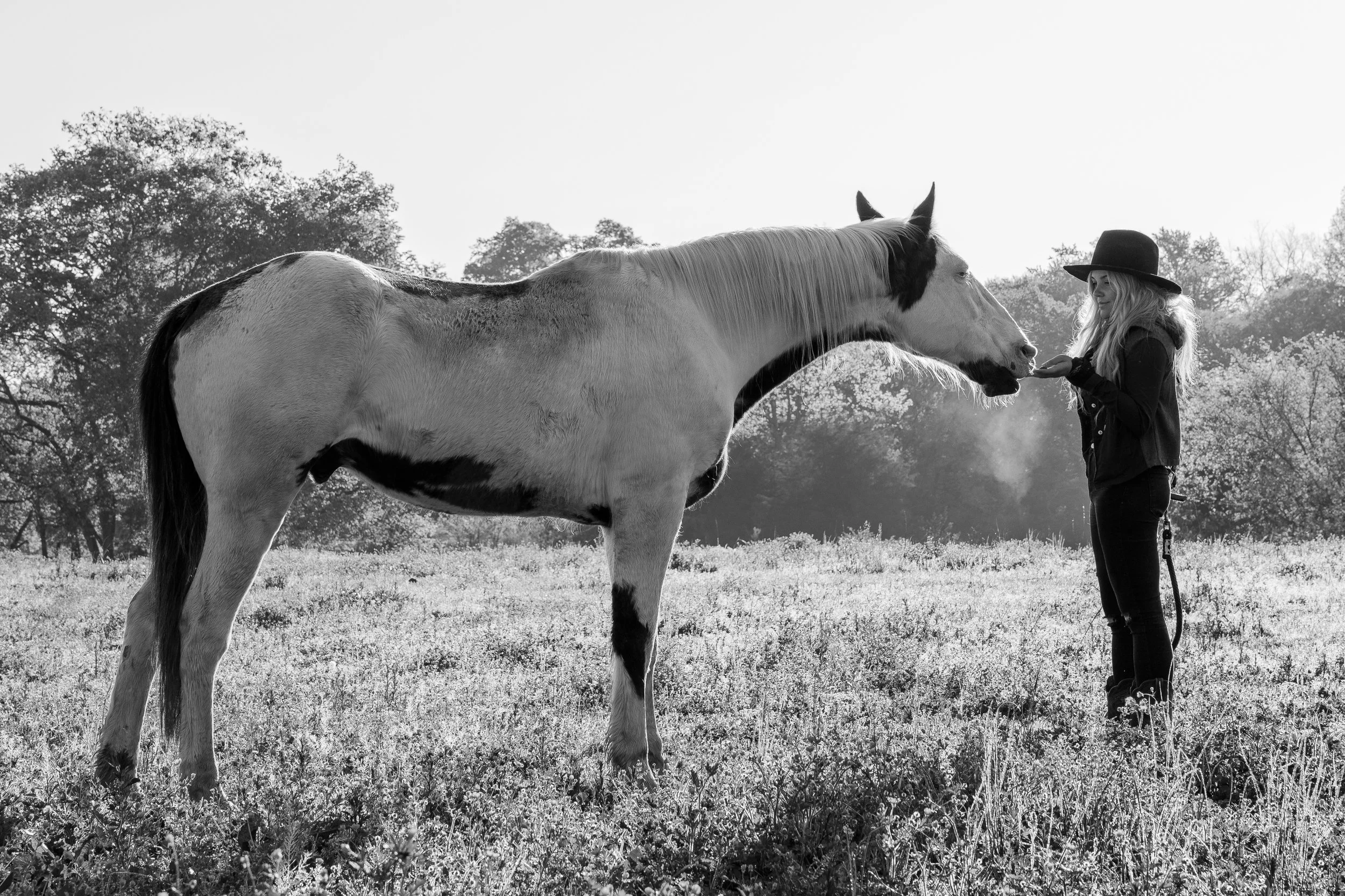
River was a Medicine Hat horse, marked like an old tale: dark ears and cap of color set on his head like a handprint, like a blessing, like somebody in the world’s deep past looked at him and said, this one is not ordinary. He had one blue eye and one brown eye. Blue for the sky above us, brown for the earth below his hoof prints. I often wondered if his eyes were a reflection of what I saw in myself when I was with him. Always lost in the clouds dreaming, but quickly reminded of earth and grateful for the anchoring of the dirt below my boots.
Down here, we’ve got our own signs—white deer, death birds, a hawk that won’t stop circling the field. But medicine-hat stories aren’t just Southern. They're the kind of stories that traveled this continent long before my ancestors ever knew how to write them down.
And what I’ll say—carefully, and with respect—is this: in some indigenous traditions, especially across parts of the Plains, horses with unusual markings were sometimes regarded as powerful or spiritually significant. A “Medicine Hat” marking has been described in modern retellings as a sign of protection, luck, or special “medicine”—a horse that carries something more than muscle and bone. Some say such horses were prized as war horses or ceremonial horses; some say they were harder to steal, harder to kill, watched over in ways you can’t explain with fences and locks.
I can’t claim one tribe’s teaching as if it belongs to everybody. I can only say what River felt like to me.
He felt like a marked messenger.
And he was old when I rescued him—old enough to have opinions about everything—and still wild. Not mean. Not broken. Just untamed in the way a storm is untamed. He didn't have that polished, show-barn shine. He wasn't fancy.
Neither am I.
And that mattered, because I needed a place to board him—somewhere safe, somewhere kind, somewhere that wouldn't look at a wild old horse and decide he didn’t fit the picture.
I was scared we’d be turned away.
Like goodness had an admission fee.
The Road that took me where I needed to go
About seven years ago, that fear sent me down the road to Innisfree Farm in Williamsport, Tennessee.
I drove out there thinking I was going to interview the barn.
Turns out the interview was for me.
That’s where I met Heather.
Heather understands horses the way some women understand gardens and weather: by living close to them long enough that they start telling you the truth. She can read a horse like smoke reads the wind.
But people? People are a different animal. She’ll tell you straight: horses are honest. Humans are…complicated.
So when I showed up that cold, early winter morning—with my careful words and my worried heart, she didn’t get hypnotized by me trying to sound “acceptable.” She listened past it. Like she was listening for hoofbeats in the dark.
Heather wasn’t judging River.
She was measuring whether I’d try to make River small.
Whether I’d use force because my pride couldn’t stand being afraid. Whether I'd treat a wild old horse like a problem to be solved instead of a soul to be honored. Whether I could love something that wouldn’t perform pretty for anyone.
It hit me then: some places don’t just board horses.
They guard the gate.
And if you want in, you better come honest.
Somehow—by grace, by luck, by the mercy of a woman who sees clear—I passed.
And that’s how River and I ended up at Innisfree…and that’s how I found the friendship that changed my life.
River stayed wild (and we loved him for it)
Here’s the truth they don’t put in rescue stories: sometimes the miracle isn’t “fixing” a wild thing.
Sometimes the miracle is giving the wild thing a safe place to be wild.
River stayed River.
He wasn't anybody’s trophy. He wasn’t here to make people feel important. He was bright-eyed and stubborn and full of mischief—the kind of horse that makes you laugh even while you’re shaking your head.
When folks saddled up their fancy horses and went out on trails like a postcard, River would decide that sounded like his business. He’d run loose beside them, mane up, tail flagged, like a spirit that refused to be left behind.
If a fence stood between him and the fun, he treated it like a rumor. He’d jump it. If a gate tried to tell him “no”, he’d bust through like rules were just suggestions somebody made for different creatures.
And the worst part?
You couldn’t even stay mad.
Because he wasn't doing it out of ugliness.
He was doing it out of joy—that wild, holy, certainty that life is meant to be joined.
George, the lantern horse
Rivers best friend was George—Heather and her husband Adam’s quarter horse, steady as old land.
If River was the flame, George was the lantern.
When River got older and his vision would go out on him sometimes, George would guide him—quietly, faithfully—like it was the most natural thing in the world. No fuss, no drama, just presence.
Watching George take care of River did something to me. It reminded me that love isn’t always loud. Sometimes love is a shoulder offered in the dark. Sometimes it’s a friend who knows the way when you don’t.
Sometimes it’s a horse that says without words: I got you. Follow me.
Fire and Water have to be paired
There’s an old truth down here that you’ll learn the hard way if you don’t figure it out first: fire and water have to be paired, or one of them turns dangerous.
If you’ve got too much fire and no water, you’ll burn your own life down. If you’ve got too much water and no fire, you’ll drown in your own quiet.
River was my fire horse, coming to me with the name River must have been life trying to braid balance into our story. Like life was trying to make sure the heat had somewhere to go besides straight thru me.
And now, looking toward 2026—the Year of the Fire Horse— I can’t help but feel that same lesson circling back.
Fire Horse energy—wild, fast, bright, freedom-hungry- can light your way or scorch you, depending on what you pair it with.
Duck River: Water-Medicine
At Innisfree we ride down to the Duck River, that ecologically diverse ribbon of Tennessee life, and we let the land do what it does best: make you honest.
When the day is too much—horses too hot, humans too tight—we go the Duck like people go to church.
Not the church with pews. The church with current.
Sometimes skinny dipping, because there’s a kind of freedom that only happens when you stop performing and let the river take you as you are. Sometimes we float and let the current carry the heavy things downstream. Sometimes we sit quietly in the sun and listen to the birds fly above as the water flirts with the tangled roots of the billowing sycamore trees.
The river is water-medicine.
It’s the counter spell to too much fire.
Natalie and our our summer of learning how to calm fire
Natalie—our other best friend, the third strand in the braid, the kind of woman who makes you believe survival is its own kind of magic. She’s deep-souled in a way that she can look at you like she see the whole creekbed under the surface, not just the ripples you put on top of it.
A couple summers ago, Heather, Natalie, and I trained our OTTBs—off-track Thoroughbreds, all nerves and heart and history. They teach you fast that you can’t muscle your way into trust. You can’t bully a scared mind into peace. You can’t pretend calm and expect a horse to believe you.
That summer taught me: progress is often invisible, healing is rarely straight, and patience is power with manners.
Heather led us through it all—steady as a prayer. The most incredible horse mama in the world—she trained us as kindly as she did our horses.
Those summer days were a whole education.
And Heather kept bringing us back to the same principles—simple enough to say, hard enough to live:
-Calm is not something you demand. Calm is something you train.
-Don’t ad more fire to fire. Add water: breath, rhythm, release.
-Make “stand” a skill. Make “walk” sacred. Make “try” worth something.
-Quit while the horse is till winning—even if your ego wants “one more.”
That’s how you turn racehorse-fire into riding-horse steadiness, one unglamorous day at a time.
Women who have lived through fire
Heather and her family lost their house to a fire a few years ago—real fire, the kind that changes your life in one single afternoon.
Natalie battled breast cancer and won—resilient and brave in the way that doesn’t ask for applause. Just keeps going.
When you love women who have survived fire, you learn something: they don’t waste time on fake. They don’t worship appearances. They see straight through what matters.
And being loved by them—being chosen into their circle—changed my life.
Hayloft nights and old-time healing
Not all medicine come from bottles.
Sometimes it comes from laughing until you cry. Sometimes from telling the truth under a sky full of stars, hands all blistered and tired and aching—while drinking a fine glass of wine out of any cup we could find—gently sinking deeper into whatever is solid below you and your head falling unto a hand woven blanket.
Some comes from sitting in a circle and passing smoke the slow, reverent way—careful not to claim what isn’t ours, but still honoring the human need to mark a moment as sacred. We let the smoke rise. We told the truth. We got loud. We got quiet.
We didn’t use it to disappear.
We used it to come back.
We’ve had nights where we laughed so hard it shook the dust loose from our spirits—the kind of laughter that says: you made it. you're still here. the fire didn’t take you.
And for a while, we weren’t trainers, or caretakers, or fighters, or grown women with full lives and complicated hearts.
We were just us. Laughing and cussing and coming back to ourselves.
Just like River and George—we don’t set out to heal each other, just to offer a steady shoulder. A lantern to hold a bright, untamable flame. A friendship that doesn’t demand, it just appears when you need it on the darkest of nights.
Rivers last Season
River stayed wild till the end. And he was adored for it.
He passed away a couple years ago—old, happy, still himself. He had a safe place, a herd, and George—his lantern horse—beside him when his eyes couldn’t hold the world the way they used it.
I miss him the way you miss a creature who didn’t just live beside you—he changed the weather inside you.
But I’m grateful, too. Because his life ended wrapped in the kind of love that doesn't happen by accident: with his best friend and a barn family who didn’t demand he become something else to earn his peace.
Because River didn’t become fancy.
He became beloved.
2026, and the invitation of the fire hores
So here we are, a couple months into 2026—the Year of the Fire Horse— and I can’t help but take it as an invitation.
Not to burn everything down for the thrill of it.
But to let the fire do what sacred fire does: burn off what isn’t true.
To let it light the path back to what matters: good land, good water, good people, good animals and the kind of life that you don’t have to pretend your way into.
And if a marked, wild thing shows up at your gate this year—don’t be so quick to call it trouble. It might be medicine.
-Eliza
Where the Wild things keep me
Where the Wild Things Keep Me
They talk in town, the way folks always will.
If you linger near the feed store long enough, or you stop for a coffee where the old men hold court, you’ll hear it said like a warning, like a joke, like a prayer turned sideways.
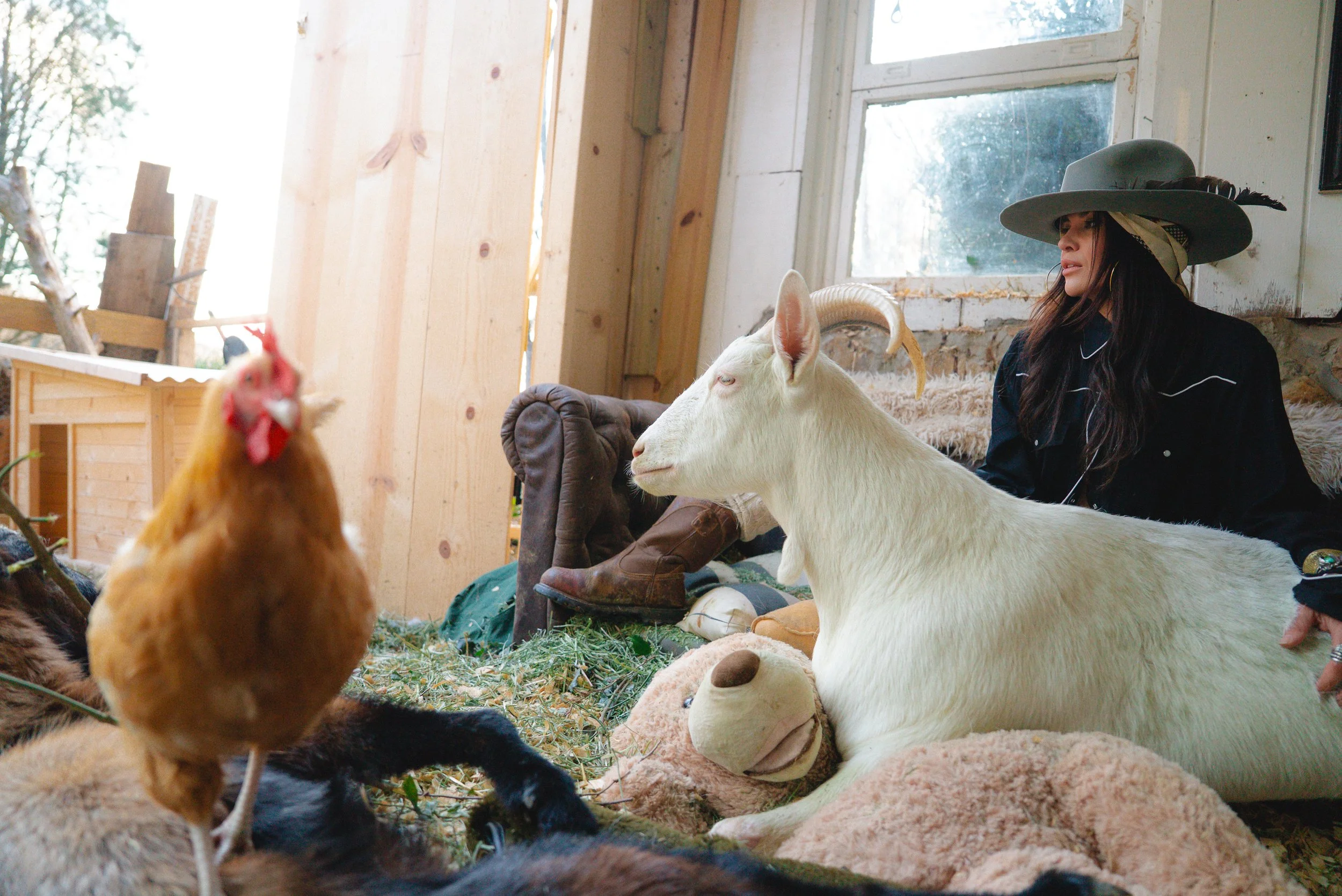
“There’s a woman out there in the woods in College Grove, livin’ alone with goats and wild things.”
And I’ve learned to smile into it. I’ve learned to stand up straighter inside it. Because it’s true—and it’s truer than most things folks say.
The cabin is my grandparents’ old log place, tucked back where the trees knit their branches together like a quilt pulled up to your chin. The first time I remember it, I was small enough to believe the world had secret doors. I called it my fairy land then. Not the kind with glitter and make-believe, but the older kind—where you mind the creek, and you mind the woods, and you say thank you when the wind spares your roof. Where the light comes slantwise through the leaves and makes a person feel watched over by something that doesn’t need a name.
As a child I thought the magic lived out there without me, like it would keep on humming whether I listened or not.
But magic, I’ve found, changes with you.
Now I’m grown, and I came back to this cabin with a life cracked open in my hands. I didn’t come back for a sweet little memory. I came back because something in me knew the woods wouldn’t lie to me. The trees don’t flatter. The ravines don’t bargain. A cold night tells the truth quick. And I needed truth like I needed air.
I lost my marriage while I was finding myself, and there ain’t a pretty way to say it. Some losses come like a clean cut—sharp, immediate, and done. Mine came like winter does in Tennessee: slow and certain, creeping in through the gaps you didn’t think were there until you felt the chill in your bones. I tried to patch it. I tried to warm it back up. I tried to be smaller than my own spirit so there’d be room for what was leaving.
But you can’t keep a thing alive by holding your breath.
So I came home to the logs my grandparents set, the place that raised my imagination, the place that made me believe in hidden gold and kindly enchantments. I came home, and the woods met me like an old, steady friend—no questions, no judgement, just that deep hush that says, You can lay it down here.
Out back, the goats became my honest congregation.
Goats don’t care who left you. They don’t care what you used to be called. They care if you show up, if your hands are gentle, if your voice is steady, if the feed bucket is on time. They watch you with those bright, old eyes like they’ve seen a thousand human dramas and decided not to be impressed.
They taught me routine. They taught me to laugh again, because you can’t stay solemn with a goat trying to climb a thing it has no business climbing, looking proud as a preacher in Sunday shoes.
And then there is Beauregard. My darling boy, Beau.
Beau has no use of his back legs as he was born with spina bifida, and if you’ve never loved an animal who requires a little extra work, you might not know what holy work it is. Beau moves through the world in his own way—sometimes slower, sometimes sideways, sometimes like he’s listening to music the rest of us can’t hear. He has needs you can’t ignore and a sweetness you can’t bargain with. He looks at me like I’m the safest place he could have ever found. I look at him like he’s an ancient god and he’s here to test that I still believe in his kind.
People call animals “just animals” when they’re trying to keep themselves from feeling too much.
But Beau is my best friend. Not in a poetic sense—in the the real sense. He is waiting for me at dawn when the world is blue and the frost still clings to the edges of things. He is waiting for me at dusk when the woods begin their whispering and every shadow looks like a story. He is there when grief tries to sneak up on me, and he makes me come back into my body: a warm head under my hand, a steady breath, a larger than life, stubborn goat that trusts me. That needs me.
Taking care of him saved me in ways I couldn’t explain to anyone who thinks love has to look a certain way to count.
Out here, love doesn’t always come wearing a ring.
Sometimes it comes with hooves and a limp, or with fur and bright eyes, or with a wildness that keeps its distance but still shares the same moon. The woods are full of neighbors if you learn how to live like you belong among them.
I used to be afraid of being alone.
Now I understand the difference between being alone and being held. I’ve learned to make friends with both.
There are nights the coyotes sing up on the ridge and it sounds like laugher breaking open in the dark. There are owls that speak like old women muttering warnings. There are deer that appear so quietly you’d swear they stepped out of another world. When the wind comes through hard, it can shake the cabin like it’s reminding you how very small you are.
And there are mornings when the sun lifts up over the trees and everything turns gold—dust, spiderwebs, fence wire, my own tired hands— and I feel something warm settle over my shoulders. Ancestors of mine and the spirits in the woods, perhaps, giving me a nudge that they are there, too.
‘Keep going’ I hear in my Grandpas gentle voice. ‘You’re getting better at this, Liza’ I hear him say under his breath, as if he’s still right next to me. The land will only give to you what sweat and blood you give back to it. And if you let it speak to you, it will tell you exactly what it needs.
Appalachian folks, twisted in with deep southern wise women, have always know that the woods are full of stories. We were raised on warnings—don’t whistle at night, don’t follow a light you can’t place, don’t call out to something that calls your name from the dark. We were taught to leave a little respect at the edge of the forest, the way you leave a little something extra at the graveyard gate.
But there’s another kind of story too, the kind folks don’t tell as loud:
That the land recognizes you when you come back with your heart split open.
That the old places don’t shame you for what didn't work. They just ask if you’re willing to begin again.
That there are guardian things in this world—some you can name, some you can't— and they don’t always show up with wings. Sometimes they show up as a stubborn little goat who needs you on your feet. Sometimes they show up as a rhythm: feed, water, hay, check the fence, breathe.
When people say. “She lives alone out there”, they mean it like a curse.
But the truth is, I’m surrounded.
I’m surrounded by animals who don’t require me to pretend. I’m surrounded by woods that have known my family longer than my sorrow has known me. I’m surrounded by the kind of quiet that lets you finally hear your own spirit speaking plain.
And I’m proud.
Proud of the woman I have become—the one folks whisper about. Proud of the hands that learned how to fix what breaks. Proud of the heart that survived loss without turning bitter. Proud of choosing a life that looks strange from the road but feels honest from the porch.
If there are fairies left in College Grove, they’re not the dainty kind. They’re the kind that live in the practical kind of magic: in the way a cabin can hold you up, in the way a herd comes running when they hear your steps; in the way Beau leans into my touch like he’s reminding me I’m still capable of gentleness.
This place was my magical fairy land when I was a kid.
But it’s more powerful now, because I’m more powerful now.
Now I understand what the stories were trying to tell me all along:
The woods don’t just enchant you.
They remake you.
And when the night falls and the goats settle and Beau is safe and the cabin creaks like its breathing, I sit with the dark the way my grandparents would've —like an old companion. I listen to the wild things moving out there, and I feel love around me, thick as summer air.
Let them talk.
Let them make a legend out of it.
I know the truest part: I didn’t come out here to disappear.
I came out here to find myself—and I did.
-Eliza Ross